
Most people know the Eisenhower Matrix. Here’s a new concept we might call the Fruit Matrix.
The idea is simple: tasks fall into two categories — Fruit, and everything else.
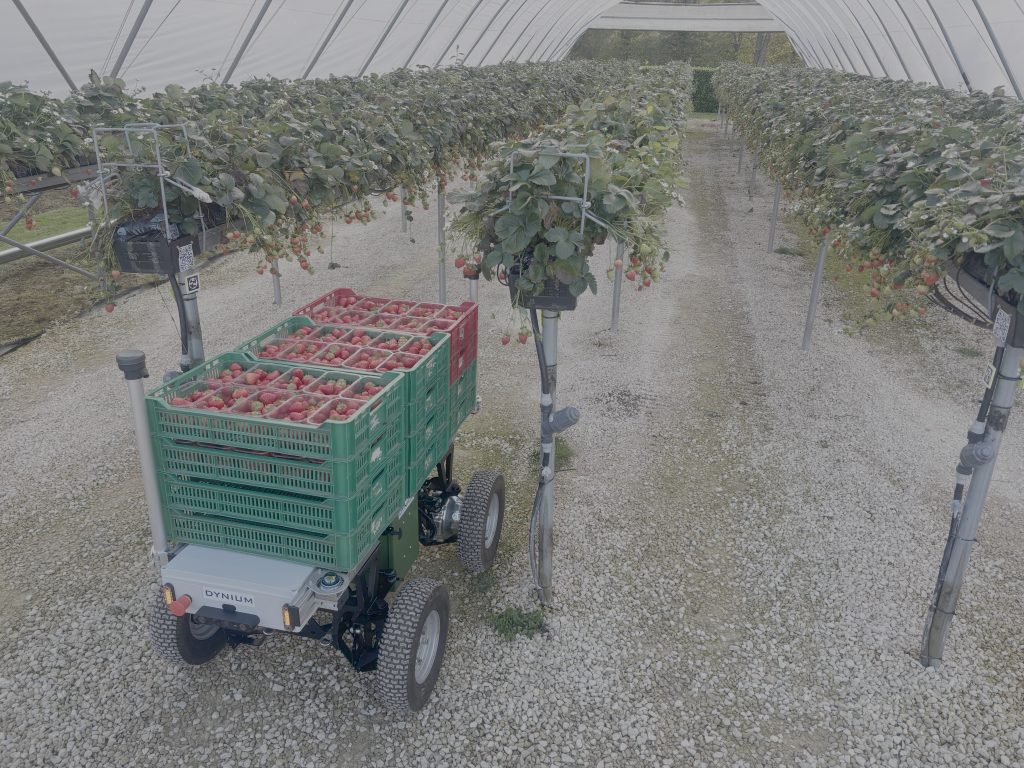
This week, my former client Ivan Wilson, entrepreneur-engineer, celebrated the latest successful demo of his new fruit-farm robot, BoB.
Following BoB’s progress since 2024 has given me an epiphany. This excellent, useful innovation showed me how businesses have responded to technology for years — arguably, in the wrong way.
AI is the latest and most influential example of this.
I’ll explain that shortly. But first, let’s talk about… strawberries.
Soft fruit is grown in polytunnels, very large indoor spaces. It is picked by people moving down lines of plants and selecting, by sight and feel, a grade/size which has been requested.
Because we demand cheap food, pickers are paid on weight not by the hour. It takes practice and skill and speed to make good money. Also, delicacy, as squashed strawberries don’t sell.
Straightaway it feels as if soft fruit picking, as described, won’t be on the early list of ‘manual tasks to be done by robots’. In fact, far from planning to replace their workers farmers must keep them happy, earning cash, or lose them.
What Ivan’s team noticed was this. Pickers regularly lost literally-valuable time pushing trolleys of fruit to a collection point. So there was indeed a function within fruit picking where AI and engineering could dovetail with human skill.
BoB was developed to do this. The robot tours the rows, collecting the picked fruit from pickers, dropping off empty trays and punnets, and taking the harvest back to the collection point.
Part of the robotic function involves navigating the uneven ground inside a poly tunnel. So here we see a function of sensors and engineering, along with software, combining to do something that is not itself skilled but which used to form part of a skilled job.
It’s easy to see here that technology is entirely helpful when it remains focused on augmenting or replacing less skilled aspects of human endeavour. Fruit picking is a skill involving judgement, pushing stuff around and weighing it is not .
Crucially, if we leave the process part in place and remove the actual fruit picking, (or even just get the fruit picking done badly,) the job falls on its face.
Now let’s take that notion and apply it to white-collar, professional jobs. Like yours.
It feels as if technology has spent 30 years demonstrating that what so-called ‘knowledge workers’ do can also be separated into ‘fruit’ and ‘non-fruit.’
We just haven’t really noticed.
‘Non-fruit’ is all the activities that require intelligence and time but don’t necessarily tax us or demonstrate genuine skill. Experience plays a role, perhaps, but mostly in avoiding clear mistakes.
There are lots of these ‘non-fruit’ tasks and tech has helped greatly to automate them. But there are limits to how far this can go. And those limits aren’t universally recognised.
There’s a beautiful example on your TV right now. The Intuit QuickBooks TV ad suggests that ‘business headwinds could overwhelm your enterprise’.
Feels credible? Maybe they are talking about the Iran war. The increasing cost of employing young people. The difficulty of prospecting new business in an online echo-chamber.
In the ad, happily, protection from headwinds is offered – via QuickBooks.
But is it?
Google tells us: “Intuit QuickBooks is a cloud-based financial and accounting software that helps small businesses and sole traders track income and expenses, create and send invoices, and manage taxes.”
Does the accountancy package select and pick fruit, in this analogy? That’s the basis of your business existing in the first place. Everything else can be as efficient as you like and reported as swiftly as you want, but so what?
We can easily helicopter up from this one example and see in general how technology has been ‘assisting business’ up until the onset of AI.
It’s been doing BoB’s job.
Like SAP, a platform designed to create efficiency within business administration. Linking everything from a salesperson’s initial customer notes, through orders, invoicing, dispatch notes and receipts. Touching numerous departments that previously generated separate admin.
All these tasks fall into the category I describe above. None of them will design a product, close a deal, develop a relationship with a customer or crisis manage any sort of ‘headwind’.
Yet whole corporations have published alleged ‘strategy’ which has boiled down to ‘we are going to make ourselves more efficient using tech’.
Effectively, decades have been spent squeezing more money out of the same picked-fruit.
Frustratingly, state taxation and competitive pressure has meant profits don’t necessarily even increase. What certainly doesn’t automatically increase, via tech alone, is the quality or amount of strawberries.
Because the things technology, alone, has been good at doing don’t actually pick fruit.
Now AI is universally in use. Performing numerous new tasks, for tech, some of which could at first sight appear to be ‘fruit’. However, when we break it down, AI’s best contributions are still the equivalent of BoB.
So, it can rapidly locate information, parse it, understand it at face value and create obvious observations or correlations.
Thinking about it, that’s just what our middle school education taught us to do with history, or whatever.
Further, ChatGPT can find, morph and set out variations on things other people have suggested in any given subject area.
That feels more problematic as it pretty much describes most of my university dissertation. Which took me two weeks to write.
But that’s where the fruit analogy still applies. Because, the idea for my dissertation was mine, and new.
For the record, I reviewed 20th-century French philosopher Husserl’s work and argued it was simply using new terminology to make points Berkeley had made 150 years before.
That’s the stuff AI can’t do. Prompt it with just “write me an interesting philosophy dissertation” and it struggles.
Demand it come up with a genuinely good creative idea that isn’t based on anything already done and it literally can’t.
On a vital Teams call, ask it to gauge the reactions and personality of the attendees you need to impress, in real time, and prompt you with your responses, and your call will be a disaster.
Look for the ‘dog that didn’t bark’ in your research report and build insight on it, and it struggles.
When some colleagues and I started our CATALYST alliance 2 years ago we built our offer around “human intelligence”, and “H2H interaction”. A lot of the latter stems from being physically in the room with other humans and creating alchemy.
A lot of the skill and judgement needed for that stems from experience. But also, quite simply, from not being a machine.
So I remain confident there is plenty of ‘fruit to be picked’ based on my philosophy background, hundreds of project insights across different industry sectors and ability to create openness and possibility, when working with colleagues.
Can you describe where the equivalent ‘fruit’ is within your own professional role and skills?
Focus on that. Then automate everything else. Always remember, as you do, that ‘BoB isn’t the real job’.
Much as we love him.

